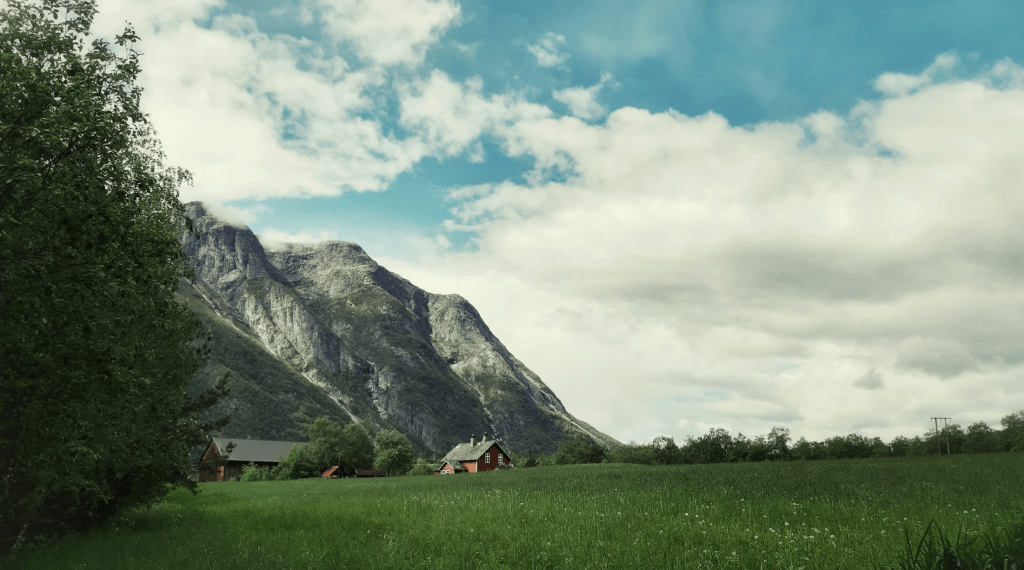
Set in 14th Century Norway, Sigrid Undset’s trilogy Kristin Lavransdatter, published from 1920-1922, is a sober and timeless work for which the author received the 1928 Nobel Prize.
The story follows the entire life of the beautiful and headstrong Kristin, the daughter of a wealthy Norwegian nobleman, Lavrans—from her innocent, bright childhood, into the breaking of that innocence in near-rape, and through the tumultuous relationship with her forbidden lover and eventual husband, Erlend.
Intrinsic to the work is a consistent supernatural sensibility, where a spiritual thread is knit into every part of the story.
Interestingly, Undset was not herself religious at the beginning of the trilogy’s writing, but she became so in the course of its writing and research as someone given to intensive medieval history scholarship. The novel was a sincere—and successful—effort to capture the reality of 14th century Scandinavia in which an insistent religious backdrop would have been unavoidable.
The work has an intensifying spiritual lens throughout, and without engaging with this lens, the complexity of the work would be inscrutable.
It is the story of a woman, at least from the character’s growing perception, working out her own salvation with the messy workings of grace leaking into every crevice—despite the sins of others, despite her own sins, many of which are obviously damaging and grave.
One could argue it’s the difficult story of a saint, as Kristin proceeds in many ways heroically through a life of trials following on her insistence of marriage to Erlend. He is handsome and charismatic, but a man of ultimately unstable and poor character, and his initial seduction of her forms the basis of a chaotic relationship that Kristin, for the most part, learns to accept and struggle through as the proportional fruit of her sin.
But if it is the story of a saint, it is the kind of story—commonly emerging in the 20th century novel medium such as Graham Greene’s End of the Affair or The Power and the Glory—where the blunt edge of circumstances force the facing of eternity, often in a mostly unwilling participant.
In the trilogy, life refuses to bend into a satisfying shape at the behest of Kristin’s will, and her only option is to either resign herself to detached, meaningless misery or to use the suffering of life as fodder for the fire of spiritual purification, placing hope in the possibility of heaven.
Something similar arises in Sheldon Vanauken’s aptly named A Severe Mercy. In the Christian perception, beyond the normal reasonings of the human mind, God can permit sufferings—even horrific sufferings—if it serves the ultimate good of the soul or souls in conversion to sincere, growing faith.
This is not unlike a surgery, permitted even by the most loving and empathetic parent, who perhaps to the child can seem unfeeling or even psychopathic, but is instead, in authentic love, allowing pain for the sake of recovery to health.
Like the child in this analogy, a person’s suffering of life in relationship to the divine can seem utterly cruel and inexplicable. We do not understand our own condition or the wisdom of who is wiser.
Throughout the story, we see this theme emerging. We are riveted by a consistent barrage of transformative imagery, poignant moments, both quiet and dramatic striking tragedies, and the desperate pain so common to the human condition. We are repeatedly asked, in relation to Kristin’s own constant tumult, about our own perception of tragedy, and the possible relationship of these tragedies to our own rebellion and lack of character.
It is nearly impossible to read Undset and not contemplate our own mortality, as well the common experience of the dissolution of earthly dreams. So much in our own expectation is shown to be a fading mirage, just as we seem to approach it. Even Kristin’s parents, who have lived and married virtuously and honorably, do not escape misery in and through the loss of their sons, the sickness of a child, and the rebelliousness of their prized daughter and her subsequent misery.
While there is somewhat more resolving of tension in moments of more obvious redemption in the work as compared to the works of Flannery O’Connor, the two authors, writing only decades apart, have more in common than not, allowing for the often grotesque reality of evil and sin to force engagement with the deepest realities. Both of the authors sensed the need of the modern reader to be dealt with soberly, as well as met never with pablum but instead the real meat of uncompromising, objective, often harsh reality.
In speaking to the real core of a person, there is room for beauty, but there is no room for sentimentality.
Kristin Lavransdatter is an honest and unflinching work about the breadth of experience of a human life, the power in the formation of character through a crucible of suffering, and the questions about the working of the divine in every person.
One cannot read the work and not be changed or left with deep queries about the meaning of existence.
 beautyrebuild.com