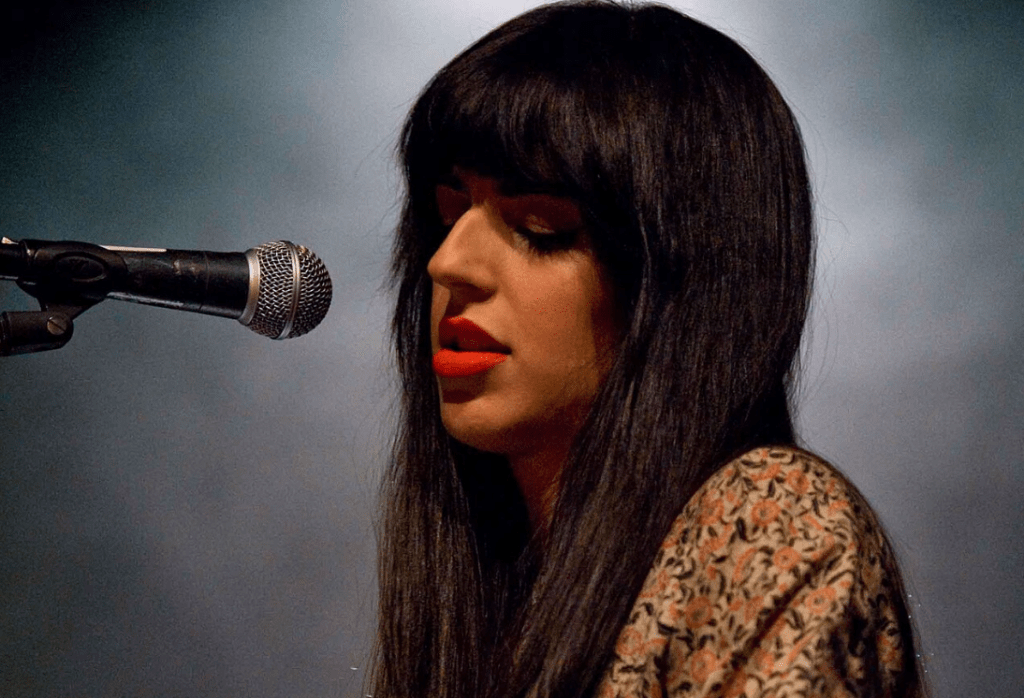
New Zealand-born singer-songwriter Brooke Fraser—more commonly known these days as Brooke Ligertwood via her worship music—shows a consistent progression in her artistic voice throughout her mainstream music albums. In her third studio album, Flags, we see clear evidence of this ongoing trajectory.
As spoken of previously, she exemplifies excellent, integrated storytelling in song, rooted in a real interior life—something which seems to be an increasing poverty within our normative popular culture.
In her previous album, marked dramatically by her encounter with the history of the 1994 Rwandan genocide, we saw an increase in engagement with deep questions of grief, loss, responsibility, and the true becoming of a human person into his or her fullest form.
Flags continues this arc, revealing an even deeper place of Fraser’s heart, mind, and life. She has almost completely moved on from love songs on the whole album’s, obviously preferring to explore more mature, universal themes and the stories of all kinds of people.
This tracks with her own life development, as she had gotten married at some point before the release of this album, but it also follows the natural trajectory of a maturing person with deepening interests.
In youth, romantic love is preoccupying. Even when it stays that way in the personal experience, artistically and intellectually, it generally becomes less interesting. This doesn’t mean one can’t write a beautiful occasional song about the experience, especially one that is truly about the more elevated, matured forms of it.
But the natural progression of an artist who is not resisting growing up is to expand the palette to many different other topics from an authentic presence to one’s interior, beyond the myopia of that singular, dominant experience.
On this album, Fraser shows up powerfully in exactly this way, augmenting her already wise-beyond-years delivery her listeners were adapting to.
We encounter a song about the serious challenges of committed love in Who Are We Fooling? (“Better or worse/I am tethered to you”); one about the constant, persistent looping of grief in the wake of a deep personal loss in Ice on her Lashes (“Didn’t want a life without you/But here I am living one”); and another about an utter kind of inner loss, disillusionment and grief in Crows & Locusts:
It was the year
The crows and the locusts came
The fields drank dry the rain
The fields are bleeding
In this track, which I remember Fraser speaking about as an analogous expression of something highly personal that required, for her, the veiling of symbolic language, we are placed in a desert kind of landscape where everything has been taken, drained dry. And yet, redemption seems to be on the horizon as the narrator declares:
She limps on up to
The top of a mound
Looks at the faltered harvest
Feels her sweat in the ground
And the burn in her nose
And the knowing in her guts
Something’s still gonna grow
She ain’t leaving ’till it does
Refreshingly, the song is almost 6 minutes long—a clear departure from the pressures of the market toward digestible, short songs which has left us bereft of more of these masterpieces with serious staying power.
That said, Fraser doesn’t only stay in a place of grief and forced sophistication, falling into the trap of seriousness as the only mark of maturity.
While it’s true she mostly leaves the love songs behind to explore the deeper and more complex themes, she doesn’t shy away from an honest expression of love. In fact, that track, Something in the Water, becomes her main single from the album:
There is something to be said for offering something wholesome and joyful amidst the honest encounter with the reality of suffering. In the end, Fraser is not afflicted by compulsive grief or a wallowing, self-indulgent pattern so many artists fall into.
We also see this expression of joy and playfulness in Coachella, about the famous California desert music festival, as well as in Jack Kerouac, about the novelist and his many travels. Perhaps my favorite track, Orphans and Kingdoms explores the profound dichotomy within every human being—both vulnerability and immense greatness:
In me, in you, fiends, explorers
Babes with coats of arms
A world inside us, a feast, a harvest
Each soul a sun, a star
Here also we see a gentle reference to C.S. Lewis (“We’re inkling children now”) who, especially on her previous album, is revealed as a primary sort of formatter for Fraser.
It is evident from this and other references that Fraser is a reader, as well as someone committed not just to singing authentically but actually living deeply such that she has a large interior well to draw from creatively.
As a result, what we see emerging on Flags is a truly integrated artist and person, living heart-forward and fully in a world that often flattens the human experience.
Fraser grieves, rejoices, ruminates, activates her mind and personal agency to interpret various events, contemplates the lives of others, and deliberately creates an immersive encounter for the listener with the fullness of life in every direction—like a prism or kaleidoscope.
Each song serves as a kind of tiny clue or “flag” for the deeper reality, leading back to inexpressible richness of each person’s life.
 beautyrebuild.com