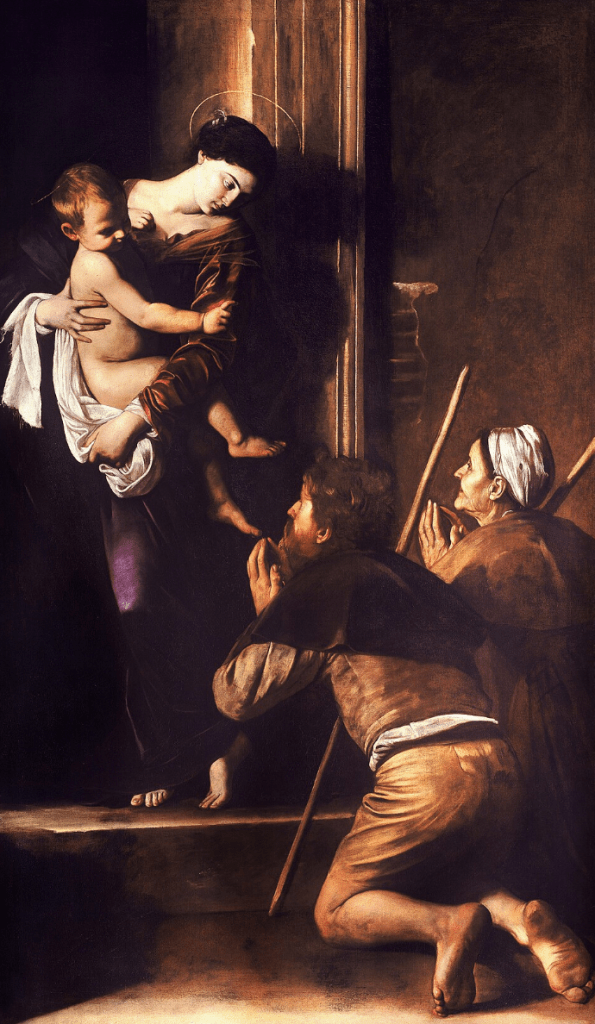
Caravaggio’s Madonna di Loreto (The Pilgrims’ Madonna) provides a window into an eternal perspective.
Found in the Basilica of St. Augustine in Rome, it is one of the 17th Century painter’s most famous, communicating in his characteristic style the dramatic contrast between light and dark, heaven and hell, human and eternal.
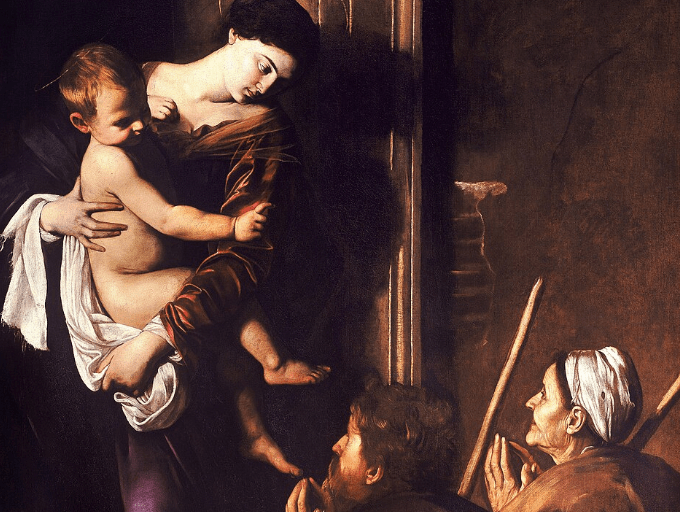
In this particular work, the light falls most decisively on the face of the Madonna holding her Child, the Christ, highlighting her as the main figure as she bestows the presence of her son, Jesus, on those who come to them, humbly seeking the divine. The light also falls notably on the face of the female pilgrim, as well as the grubby bare feet of the male pilgrim. They both kneel, beseechingly, at their feet, while Christ imparts a blessing.
Both the Virgin and the Child are elevated in the painting, in at least three ways: through standing in contrast to the kneeling of the pilgrims, as well as being on an elevated platform, while presenting in royal clothing made of rich fabric; the pilgrims, evidently coming from a long journey, travel sticks in the frame, are beautifully disposed to humble themselves between both the tiny King and his chosen Queen and Mother, Mary. Awe and joy imbue their worn faces.
I remember the first time I stumbled into this painting in Rome—my first encounter with Caravaggio. I was arrested by its beauty, struck deeply by the heavy contrast and its pull toward depth. That memory reminds me acutely also of my experience with the Basilica di San Francesco in Assisi.
One immediately, upon contemplation, places oneself among the pilgrims, aware intuitively of the symbology of the dirt-covered feet left exposed for the centuries: our disposition before the eternal realities must necessarily be one of humble recognition of our earthliness, ever covered in the grime of this world as we make our way, stretching toward the elevated, noble calling it is to be human—embodied profoundly in completion in the Blessed Virgin Mary.
Just as soon as this recognition hits, one is also stunned by the reality of the generous offering in return of light, blessing, warmth, and motherly love from the two figures elevated above—the simplicity of our gift is decisively outdone by the abundance of Heaven. Mary gently presents her son to those willing to allow themselves to be small before him, unashamed of their limited but eager humanity.
Known for his encapsulation of rich theological and human truth contained in his paintings, Caravaggio offers a real invitation into a deeper contemplation of eternity as well as the pulsating questions of the human heart. His characters are animated and lively, and the depictions of Christ and the saints are often—while not lacking warmth—strong, regal, and elegantly unmoving.
The true meaning of existence, he communicates, is that of the pilgrim, of discovering and submitting to our true state of dependency; we are made of dust, and travel through our lives covered in it—but that precisely in living this reality in full, we are given the intoxicating beauty of Heaven. Classic art like Caravaggio’s is not the only way toward deep beauty in the visual arts, but it forms a critical substrate to all discussions of the meaning of artistic representation.
Whether directly translating the work religiously or interpreting it at a simple symbolic level, to encounter a Caravaggio in person is to be changed.
 beautyrebuild.com