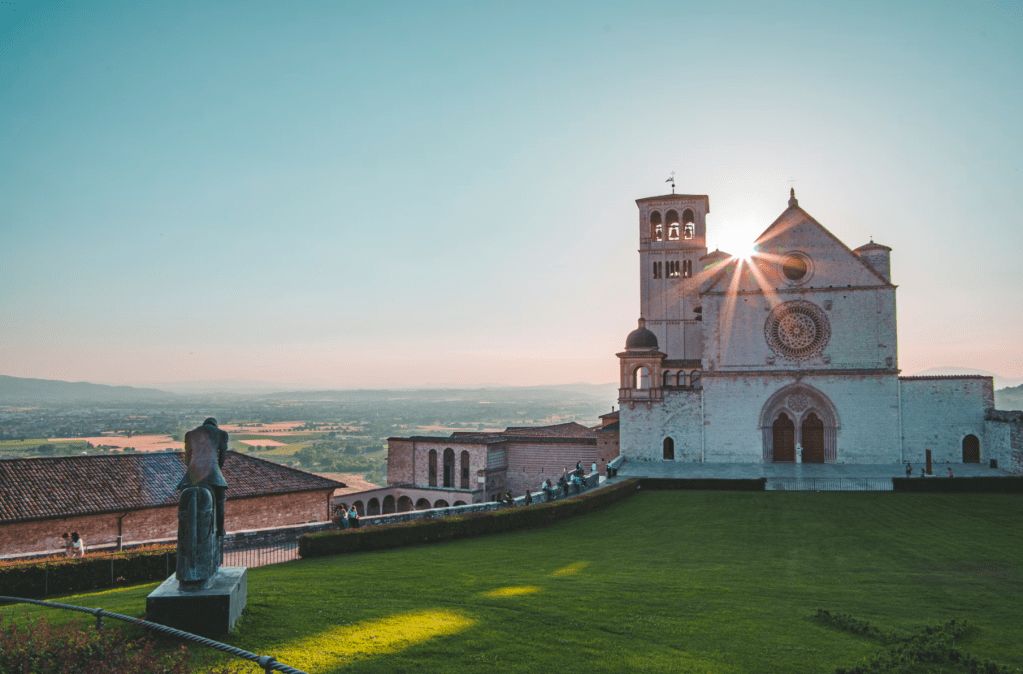
The Basilica of St. Francis of Assisi, or the Basilica di San Francesco, remains an Italian treasure, for many obvious reasons.
As building of the great basilica commenced in 1228, following the death of the mysterious figure St. Francis said to have been marked by the gruesome stigmata, did anyone imagine the flocks of international tourists in fanny packs and runners gazing up at the frescoes in inquisitive awe?
The exact parameters of its greatness and effect could not have been prophesied. But those building the basilica must have known they were building something for the ages, in order to tell the story of both the great St. Francis, as well as the strange, divine force said to have driven him to his stark poverty and witness to the life beyond the senses.
One cannot help but be bowled over by the exquisiteness of the now-ancient structure, which embodies a synthesis between the Romanesque and Gothic architectural styles. To step into the San Francesco Basilica—at least with an open and attentive heart—is to be changed forever.
I remember the first time I went. It was also my first time in Italy, and I had already been transformed by the beauty pouring out to me on every corner. But the day after our relatively brief stop at this pilgrimage point, I woke up with a distinct sense of eternity in my chest—what I have now called for many years, even putting it into a song, a “beauty hangover.”
This place is one of holiness, peace, and yes, profound beauty.
The frescoes, strange and lovely, borne out of a desire to express redemptive realities from the history of Christianity, cover large swaths of the ceiling and walls. One of the artists whose frescoes populate the church interior is the strange and compelling Giotto, a favorite of mine whose often odd proportions and features in his works lead the mind and heart into the central themes of the story.
The basilica itself is enormous and awe-inspiring, towering to make one of the most beautiful skylines on earth over the exquisitely cultivated Umbrian countryside. Its ancient stone, whose character bleeds into the roads and architecture of the whole town, kept remarkably beautiful over many centuries, communicate a lasting testament to the glory possible through one man’s life lived completely in sacrifice and mysterious love.
St. Francis had been born into a wealthy family known for beautiful fabrics. He had lived a life of use and abuse in nearly every category, but is said to have been transformed in an encounter with the San Damiano cross in a small, dilapidated chapel.
In this chapel, he heard a voice tell him to “rebuild my church.” Taking this to mean the literal chapel he was in, he began rebuilding it.
But as many know, the story only began there. Instead, St. Francis went on to transform himself, at the cost of shameful, public disowning by his parents, into a poverty-stricken beggar whose growing collection of men and women—including the famous St. Clare—committed themselves similarly to witnesses of the paradox of the Gospel.
Many would now argue that at a time of clerical excess, St. Francis did indeed rebuild the church.
It is fitting that he would have then also inspired the building of such an impressive basilica, proclaiming his story and the story of grace to generation after generation.
To enter the Basilica of St. Francis is to be haunted forever; it is to be swayed by the mystical power of beauty; it is to be challenged to become more and to humbly shrink before the ancient strength of a mysterious religion.
Although Assisi, due to its fame, has become something of a clichéd stop for international tourists, it’s worth remembering that clichés of all kinds are clichés for a reason: deep, common, patterned resonance.
Many remark at the notable feeling of peace upon coming into the town, and especially the basilica. Whether it is an experience of St. Francis himself, him as conduit to a true divine power, or simply an encounter with the heights of human capacity in beauty and virtue, visiting the Basilica of St. Francis is a life-transforming experience I wish upon every person alive.
 beautyrebuild.com