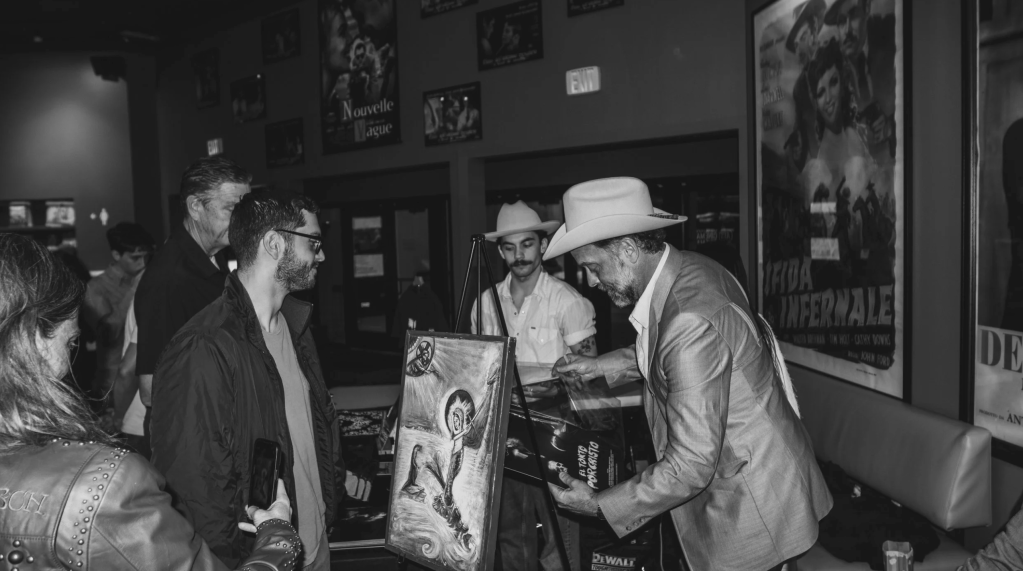
A remarkable independent film, El Tonto Por Cristo, was released this past year. The film’s name translates from the Spanish into the English “A Fool for Christ,” referencing the long-standing Eastern Christian spiritual tradition of the “Holy Fool.”
Presented completely in black and white by filmmaker Josh David Jordan, El Tonto Pro Cristo features an Orthodox monastery in the American south, inviting the audience into a distinctly strange and mystical space of contemplation.
The use of the Spanish in the title is a clear editorial choice, adding to the rich texture of the story: Anglo, Texan, Mexican, Orthodox, Eastern, Russian, Western, modern, timeless, melting pot, rhythmic, chaotic, worldly, monastic.
What emerges from the collision of all of these varied elements, primarily, is a unified mystery of the essence of the soul before God. The paradoxes and juxtapositions—the unavoidable seeming disparities of human life in a post-Eden world—make plain the core.
It brings to mind one of the Eastern Christian titles for Mary spoken of in the Akathist prayer: “Reconciler of Opposites.” In this understanding, she is held up as the perfection of human nature, able to hold within her all of the complexities of existence without breaking, and thus enabling her children to grow into a similar wholeness of being.
This reconciling within themselves seems to be the calling of the characters in the film.
Slow-moving and meditative, the film loops around the strange and often disorienting behavior of Father John among his community of monks in the Texas countryside. It is not plot-driven, but rather pulsates with the inner life of the individual monks whose experience of Father John informs their life, laid bare before the mystery of existence.
The story, whose aesthetics and movement are said by many to echo Tarkovsky, excellently captures the quiet and strangeness of the monastic life: in turns serious, bewildering, comic, and sorrowful.
One sees that that monastic life, rather than drawing the men into plain conformity, instead gently nourishes the true personality—the same personality that must be disciplined and directed, and yet, in this paradox, allowed to fully emerge.
The directors expertly illuminate this core principle of traditional Christian understanding: that one must lose one’s life, even entirely, in order to gain it.
This paradox and conflict is seen perhaps most strikingly in the character whose past life as an actor becomes a pinnacle and central drama to the story.
Father John emerges within this context as a symbol of total freedom—from outside perception, from the constraints of expectation, and even, as we see in the entrancing opening scene, from his own profound early sorrow, likely to have originally driven him to life as a monk. He, too, has a complex backstory—seemingly long-conquered.
With both the seriousness of eternity and human life front and center, and the eccentric and sometimes unsettling joy of Father John dancing on this foundation, El Tonto Pro Cristo provides a satisfying and transformative encounter with the deepest questions of human longing, allowing for a squinting, blurry view of the contours of the divine.
 beautyrebuild.com