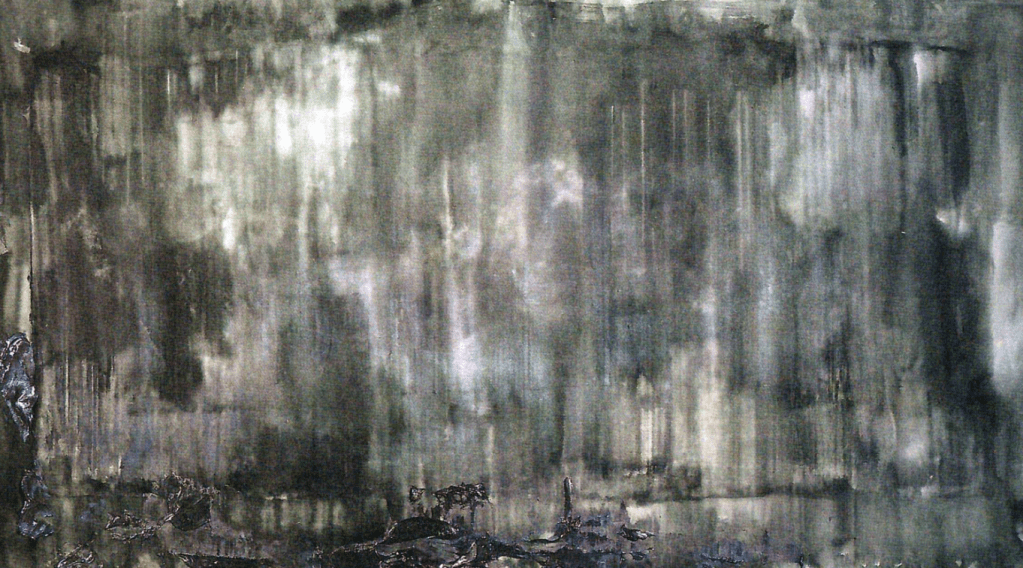
Terrence Keller, the great man and painter, was a Canadian national treasure with international reach. Well before his death in 2014, he had become a renowned contributor to the formalist abstract art movement, with exhibitions in many museums, international buyers, and entries in various definitive texts on formalism and even the Canadian Encyclopedia.
He was also my uncle.
As a child I experienced him fully: as the one man in the world I knew with a ponytail; as the kind man who did Tai Chi in the backyard when he’d come to visit; as the man whose home with my aunt had giant canvases covered in thick paint all over the home; as the man who dropped extra dimes in a brutal Canadian winter into the bus change receptacle so my sister and I could come to his studio and explore abstract sculpture.
He was a profound gift in his life, and this gift continues even in his death.
Most of my personal artistic formation, particularly in the visual arts, is in the classic forms. I am not normally drawn to abstract forms as a preference.
But I have long loved my uncle’s paintings, and in my adult years have come to understand this is not just a love from personal affection but from the intrinsic excellence in his work, noted by many both in and outside of the established art world.
Notably, I believe my formation in more traditional art forms and architecture ultimately only convinces me more of his gift. I am hard-wired for beauty, and for what sits well in the heart when one gazes upon it. In classic art, we often discuss the Golden Ratio, and Rule of Thirds—as ways objective beauty can be captured in a structured painting.
What is fascinating in my uncle’s work is that the instinct of the heart for beauty is obviously present, despite an intentional departure from structured realism.
I don’t believe this can often be said of many modern and abstract works, which often seem to convey a certain nihilism and adolescent rejection of order and beauty. One often sees what appears as simple rebellion rather than an authentic and meaningful expression of the soul beyond words.
Keller’s work is not like this. A man whose bent back proclaimed an early childhood struggle with polio—the same polio which would eventually take his life in his sixties—his suffering became a tremendous avenue to the expression of beauty. Despite constant pain, the dominant sense in his work is one of hope, extravagance, abundance, and an orientation to a world beyond the grime of much of regular life.
None of his paintings screech out death, darkness, or depression. Instead, an encounter with his work is an encounter with the mystery of existence: layered, textured paint in exquisite color, brought into balance perfectly via an instinct of genius.
The heart, mind, and soul rest when gazing at his work. These paintings are exquisite in homes, offices, hospitals—anywhere where beauty and artistic intensity is welcomed.
More about his work can be found here.
You can also experience a complimentary Art Episode of mine which hinges around his work here.
 beautyrebuild.com