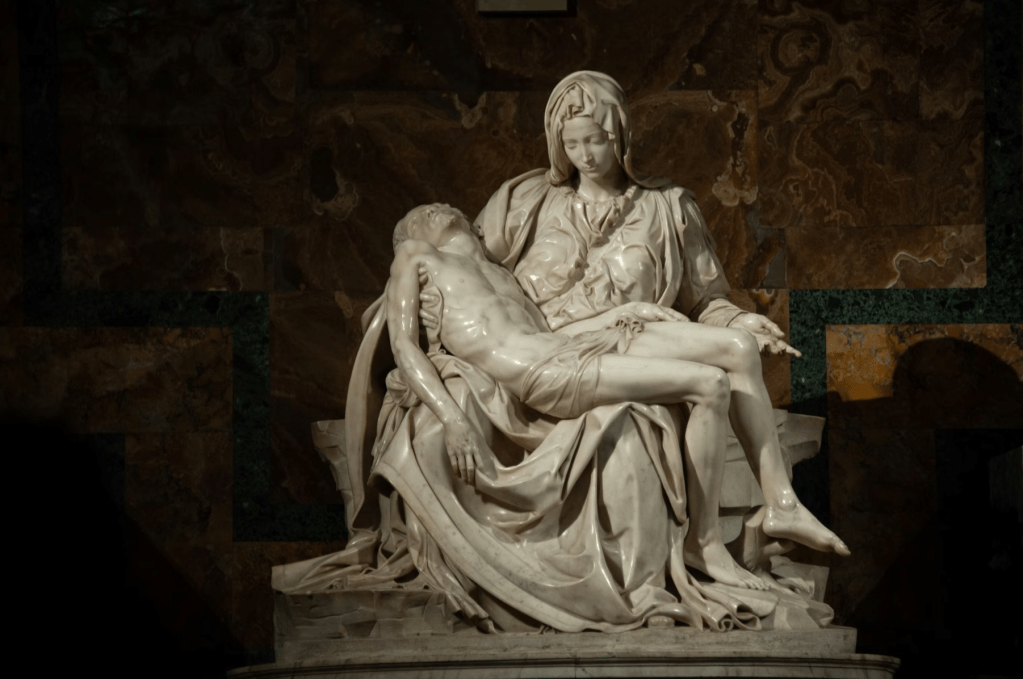
There are few sculptures as stunning as Michelangelo’s Pieta, where the Blessed Virgin Mary holds her Divine Son in her arms, post-crucifixion.
All I remember was being utterly arrested when I walked into St. Peter’s Basilica and had time to gaze at it, tilting my head in wonder at the encounter. I was so mesmerized that I spent six or seven hours over the course of several days in front of it, feverishly taking notes of everything I noticed. Keep in mind, this was in the midst of Rome, with more than I had to time to see. The Pieta, though, commanded my commitment.
There were occasional tour guides whose descriptions and historical accounts I overheard in fragments, and these spurred me on to deeper contemplation of the work. I remember them noting that Mary was notably large, intentionally lacking proportion to the full-grown man in her arms, and that this was meant to evoke the Mother and Child from when He first entered the world as a baby, thus revealing the tragic, deeply poetic juxtaposition between new infant life and bloody, torturous death.
The Pieta is, in fact, something that can only be fully experienced; it cannot be described. Take for example the sensitivity of the Virgin’s face, filled with resignation, sorrow, peace, hope, and mysterious authority simultaneously. Her disposition is one of release and perfect submission to God, despite the violent horror of what she has just witnessed.
Consider the vulnerability and meekness of Christ, allowing himself to be offered up for the world—and, in fact, evoking the proclaimed sacrifice of himself on the altar at Mass, known by Michelangelo, as he wraps himself humbly over the knees of the Virgin.
This kind of symbolism overflows through the genius of the artist—enough to have filled hours of my amazement at the time, and certainly much more for those historians and students of his.
One cannot speak of the Pieta, however, without directly highlighting the craft of the sculptor: at only 24 years old, the man is often reported to have “seen” the sculptures he was about to create inside the marble, somehow already mysteriously alive, before beginning the laborious process of chipping the stone away to reveal the masterpiece underneath—as if it had been there for all time, waiting for him.
Perhaps it had been.
The level of excellence, discipline, and talent required for such a feat is something we must look for again now. And no less: we need to revive a culture of patronage for those artists capable of transforming the minds and hearts of today and perhaps down the centuries.
At the same time I was stunned by the sculpture, I was also bewildered to find tourist after tourist come up, phone in hand, viewing the Pieta through a camera lens, taking a photo, moving on—and never realizing that despite the effort of travel to get there, they had still never actually seen the famous work.
I experienced it partly as a personal affronts if it was a careless rebuffing commanding of respect. But mostly, I experienced a sadness at our lack of attention.
However, a piece like Michaelangelo’s Pieta is built for the eons, persisting for centuries prior to iPad-laden tourists, and ready to persist for centuries more.
May this be the kind of permanence we again love and honor, and via that honor, be inspired to create and support.
 beautyrebuild.com