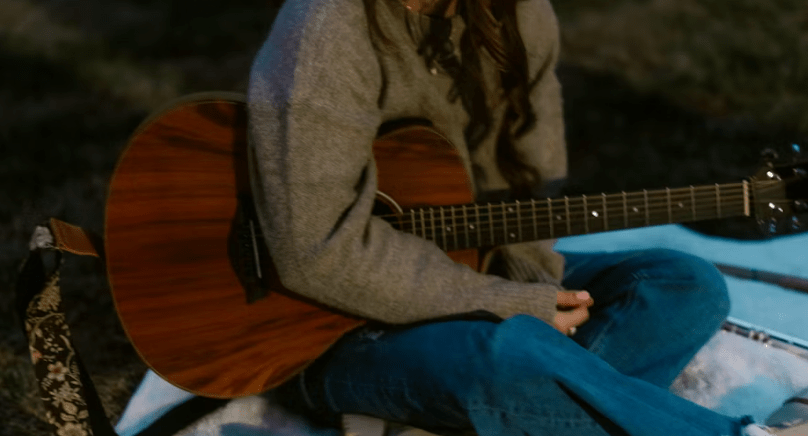
Jewel’s original album, Pieces of You, with hit songs such as Who Will Save Your Soul, You Were Meant for Me, and Foolish Games, released in the midst of the grunge dominance of the 90s, transformed the music scene then. Today, it remains a significant cultural mover.
As Jewel has often spoken of in interviews, her work was almost forced into the scene by the signal power she had amassed via playing weekly at the now-defunct InnerChange in San Diego—an arrangement begun as a mutual Hail Mary pact for survival between a homeless songstress and the coffee shop owner.
While record labels had a bidding war to claim her, Jewel remained sober and grounded, concerned always about retaining the rugged authenticity that has formed and sustained her in the most challenging time of her life.
Jewel’s lyrical style, clearly informed by both a tough Alaskan upbringing and the tragedy of homelessness herself as a young woman, is clever but leans direct and earthy rather than highly poetic. This is, in her case, not a weakness. She is never even in the neighborhood of ivory tower.
She had so many true, shocking, and rich experiences that to simply describe them well was power enough. She intuitively understood that life itself, in its organic details, carried substantial symbolism and that unfiltered, unashamed emotion communicated heart to heart, as she saw in her growing audience at the InnerChange originally where grown men would regularly cry.
I encountered her work as a very young child, years after the drama of her choice to refuse the original million dollar offer in exchange for a slower, more human route, with years peppered by almost-certain failure before her adjusted first album skyrocketed her to global fame.
I was far too young at the time, I can see now, for a lot of her themes—violence, sex, rage, death, homelessness, drugs, prostitution. I had older sisters, and they had older friends, who also had older siblings, so I was easily 10 years ahead of my time. All of my friends were listening to the Spice Girls, and I was busy being enamored with Jewel—and the other female songwriters like her—and her way of communicating visceral human experience through lyrics and stories.
For me, however, with most of the significance of the more adult themes flying over my head, the song that gripped me and changed me was the little-known, shamelessly long 7-minute “Adrian,” about the tragic accident of a young man, rendering him permanently disabled.
At that time, I was watching my own sisters upstairs suffer from a genetic terminal illness that was also gradually disabling them. The song spoke immediately to my experience, not shying away from the complexity of it all, and gave me a language to understand some of what I was navigating:
An unfortunate accident in a canoe
Doctor said, I’m sorry, not much I can do
And the air was so still
And his eyes did not blink
Adrian, come out and play
Little Mary Epperson liked him
And she vowed always to watch after him
But he still did not move
And the doctor said it’s no use
Adrian, come out and play
It was here, listening to Adrian, that I would say I received my own vocation as a singer and writer, with the desire born in me to tell stories and affect people in a similar way. I understood, immediately, its power. Authentic songwriting, rather than often the simulacrum it’s become in a market-driven world, offers an invitation to communion and intimacy. It is not a display of narcissism and ego, the uncovering of something real.
The reality and humility Jewel embodied in her earliest work she continues to embody now, decades down the line and many more marks of suffering later: the loss of her fortune to a deceptive mother; the divorce from the father of her son; the ravages and stresses of a life lived in the spotlight.
Her Pieces of You album especially captures this gift of persistent, unfiltered humanity that defines her as person and artist—something we need perhaps now much more than when she first cut through the 90s grunge on radio.
 beautyrebuild.com